Showing posts with label reviews. Show all posts

Sunday, March 29, 2026

Reading List: Developing Successful Grants: How to Turn Your Ideas into Reality

Awww, the good old days of the early 2000s :D 

In my defense, I just discovered this book this month, so this isn't one of those that I've had on my to-read bookshelf so long it's gone out of date while waiting for me to read it.

This is an insightful analysis of the process of writing grants, with lots of good ideas of how to go about the process, from first knowing what you need to fund then to finding grants, writing the application, using a Common Grant Application, preparing your budget, on and on. 

The book was written in 2005, so reading it in 2026 there are quite a few "tips" that are now outdated (like saving your documents to a zip disk, going to your local magazine store to purchase a phone list, and not submitting electronically); however, overall the advice and process is still relevant and helps you avoid pitfalls. 

The Upsides:

  • Start with taking an inventory of your needs - program needs, equipment, etc. Once you know those things, then you can begin looking for funding. 
  • They lay out the process in really easy to understand steps.
  • There is lots of advice and quite a few samples (samples of how to format goals vs. objectives in a table, samples of breaking text into bullet points to be visually appealing, advice on using emotional language, etc.).
  • They explain how to make the general layout they recommend match a funder's RFP or required layout.
  • They include what items/aspects you should include in your application, even if the funder doesn't ask for it.

The Downsides:

  • The age of the book. There were quite a few things that I thought, "Ooh! I didn't know about that. Let me go look it up," only to find a website that is for sale instead of having whatever it had in 2005, or the aforementioned tip of getting a list of funders at your local reputable magazine store. (There were also a number of suggested websites that I remember from long ago, felt nostalgic when reading about them, then was sad to visit their website and realize they don't exist anymore or not in the same way they used to.)
  • One thing they repeatedly highlight is having a group to work on grant applications, including people familiar with the program(s) being funded, a proofreader, a writer, someone to compile everything, community supporters, ... These are great ideas and would certainly help a grantwriter feel less pressured and stressed, but let's be real - how likely is it a small organization is going to have that many people available to help with a grant? Even if you recruit members of your community for some of these positions, you're still not likely to have this grand Team they recommend. But it's a nice ideal.

Overall: This is a really great look at the process of writing grants, and despite the age of it, it's still very informative and useful. I recommend this to people working on finding funding and preparing grant applications, especially people who are new to the role.  


Developing Successful Grants: How to Turn Your Ideas into Reality, 2005
Mike DuBose, Martha Davis, Anne Black, and Research Associates
230 pages


Reading List: Things Great and Small: Collections Management Policies (2nd ed)

Sometimes I'm so ashamed by how long books sit on my bookshelf before I read them. I see them in the store or online, I get really excited, I buy them, and then... I just don't have time to read them. I bought this book when it was new (2018) but didn't read it until this month. Yikes! At least nothing's too outdated yet!

This is a nice overview of collections management policies - different types of policies you should have, what you should take into account, why to have policies, who should be involved in writing or approving different policies, all that good stuff. It also includes topics like risk management, intellectual property, and ethics.

If you've read a lot about collections, collections management, and policies, there's nothing really new in here; but this is a great synopsis of collections management policies if you haven't read a bunch others, or a nice one-stop-shop of all the good stuff to get you going.

Plus, John Simmons is funny. If you're on any collections e-lists with him, you likely know his December holiday-themed/museum-management-themed poems. (I was disappointed, though, that the funny wasn't strong throughout. He starts off well, with sample policies from the House of Victoriana, the Institute of Contrafactual Science, and the Museum of Mediocre Art, but then some of their sample policies are just like regular sample policies and the funny is gone.)


The upsides:

  • A nice one-stop-shop of all the good stuff to get you going on your Collections Management policies
  • Good for newcomers to the Collections Management game

The downsides:

  • If you have other books about Collections Management, you might not need this.
  • There are a number of "When Policy Meets Reality" call-out boxes scattered throughout the book, but a lot of them seem irrelevant. They're funny or interesting or astounding, but they're not always helpful. If you try hard, you might force yourself to stop and think about what you would do if you were in that situation, but there's not a lot of insight offered. And others just make you think "Huh, that's... interesting" and you move on. It's some wasted space that could have either been used for more helpful info, or could have just been cut and made the book a bit smaller. Similarly, a lot of the images seem unnecessary, and removing them could have made the book smaller. (I keep saying "smaller" because it's a tall and wide book - 11" H x 8.5+" W)


Overall: This is definitely worth a read, unless you Absolutely Know Everything about collections management and policies. Even if you think you know a lot, you still might get some new insights. Or you might gain a new favorite reference book.


Things Great and Small: Collections Management Policies, 2nd edition, 2018
John E. Simmons
220 pages (and it's a tall and wide book, too), including references/bibliography/other reading, and appendices with AAM's Code of Ethics, AAM's Accreditation Commission's Standards Regarding Collections Stewardship, various laws and regulations that affect collections

Reading List: Getting Caught Up

Hey, I read a museum-related book! Lookatme! (Yikes). I'm trying to make more of an effort to read museum- or nonprofit-related books again (Didn't I say that before, too?), and this year I've read five already! ... Okay, some of it has been because it's been painfully slow for me at work lately, and I've had to create projects to keep myself occupied. One of those was finally reading a bunch of books our old Executive Director gave my then-manager when she retired and cleared out her office. My then-manager gave the books to me to store for our department, and now that I've had NOTHING to do, I decided it was finally time to read them!

Book #1 was The AAA Way to Fundraising Success: Maximum Involvement, Maximum Results, which I really learned about in a webcast I watched (DonorPerfect Community Conference 2025, Robbe Healey "Stay the Course: Individual Giving Tactics for Changing Times"). The book sounded useful, and the cover the presenter showed started to seem really familiar... and then I realized it was because it was one of the books our Director had given us that I'd been wanting to read! So I dove into it.

The book is super short but super useful. It helps you think about how to structure your organization's culture of philanthropy and how everyone can be involved. It's specifically focused on getting your board involved in cultivating donors and partnerships, but it can be applied to anyone. 

Kay Sprinkel Grace says there are 3 types of people needed: Ambassadors and Advocates to talk up your cause, make connections, and lay the groundwork, then the Askers who do the actual asking for a donation. She describes the function of each of the roles and explains what personal traits make for a good fit for that role, and also gives ideas of how the different roles interact and work together.

This was such a fantastic way to show that fundraising isn't only about asking for money; it's about getting the word out and building relationships, too. And we can all play a part in that. Someone may not feel comfortable asking someone for $$$, but can talk up the cause they believe in.


Book #2 was Asking: A 59-Minute Guide to Everything Board Members, Volunteers, and Staff Must Know to Secure the Gift, by Jerold Panas. This was a quick, easy-to-read reference book, yet it felt like it was giving you everything you need to know. He lays out the cultivation and solicitation process step-by-step, from identifying potential donors to writing an introductory letter (I'm not sure how much of that is still relevant today) and making an introductory phone call to having a first conversation (but not asking for money yet) on through to the Ask and follow up. Panas gives great tips, makes it all seem really easy, and even gives advice for when the donor says no or when you only think they've said no. Like The AAA Way to Fundraising Success, this would make a great reference book to have handy to keep fundraisers on track and motivated.


I'll mention book #3 for the year quickly because while it wasn't exactly useful, it was fun to read: The Principles Of Museum Administration, George Brown Goode's 1895-ish treatise of the workings of museums (reprint purchased on Amazon). It was really interesting to read as a historical record of how early museums in the U.S. were perceived and run, and how much of what he wrote is still relevant today!

I originally hadn't planned on writing about The Principles of Museum Administration because it was so short, and hadn't even thought about writing about the fundraising ones, in part because I've been reading them at work (different environment, so I didn't make the mental connection between reading and blogging) and in part because they're not museum-related. However, museums obviously need to fundraise, so even though these books aren't about collections or exhibits or other museum-specific areas, they are relevant to museums. 

So there you go! Museum- and nonprofit-related books I've been reading in 2026. I've got two more that I've finished reading recently, so stay tuned for those reviews!

Sunday, July 30, 2023

Reading List: Registration Methods for the Small Museum

book cover of Registration Methods for the Small Museum
Well... I just don't have much to say about this one. I usually have lots to say about nearly every book I read, but this just wasn't one of them. And I don't know why. 

It's a fine enough overview of registration needs, methods, policies, forms, etc. It's the kind of thing you could give to someone NEW to collections and registration (a new volunteer, or someone running a museum starting their Collections department, including procedures and policies, from scratch), and it would give them the very basic knowledge about why we do things and how to go about doing them. But it was dry at times (most of the time?), and just... so basic and factual that there was no pizzaz or pah! to the book. It was just "Here it is. Just the facts, ma'am." Even the author's first-hand anecdotes were just blah.


The upsides:
  • It has the very basic info, including the What, Why, and How. 
  • Sample forms and policies
  • It has a good chapter on using computers for your collections - what to look for in software, security, hardware, and networking. Again, just basics, but enough ideas to get you started.

The downsides:
  • It felt boring. I mean, okay, maybe some people wouldn't find this kind of thing interesting or exciting in the first place, but you and I do, right? That's why we're here, writing and reading this blog post. So for *me* to say "Eh, it's dry" says something.

Overall:
I feel like there are other books covering the same info, and more in-depth, but if you just want a Basic "How and why we do this," this would work. And that type of book absolutely has a place and an audience, but if you've been doing this for a while, or want something less snoozy, maybe look for another book. I'd still give it 2.5 or 3 stars out of 5, though: a nice middle-of-the-road, did-what-it-came-here-to-do rating.


Because I feel like I'm so down on the book and not doing a good job of explaining its value, here's the Table of Contents, so you can see that it *does* cover useful topics:
  1. Why Have a Museum Registration System?
  2. Acquisition
  3. The Accession Number
  4. Accessioning
  5. Documentation
  6. The Catalog
  7. Loans
  8. A World of Computers
and then sample forms and policies.


Registration Methods for the Small Museum
, 2018
Daniel B. Reibel, updated by Deborah Rose Van Horn
105 big pages of text, 33 pages of samples, and a bibliography

Saturday, March 18, 2023

Reading List: Recording Oral History: A Guide for the Humanities and Social Sciences, Third Edition

book cover for "Recording Oral History" third edition
One of my favorite types of projects for museums is transcribing oral histories and interviewing people about their lives. Mostly I do transcription, but for a while I was also interviewing a certain group of people. Between hearing over and over one particular interviewer whose style I didn't particularly care for, and wanting to maybe do more interviews myself (while not wanting to sound like the interviewer whose style I didn't care for), I decided to expand my library to include books about oral histories. 

Valerie Raleigh Yow's book is a really great overview of oral histories, and possibly answers every question you might have about preparing for an interview, conducting the interview, what to do after the interview, and how to use the quotes and information you get. 

Yow starts at the very beginning of the history of oral interviews and passing down information orally, which made it seem like the book was going to be dry and boring. (A good portion of each chapter is bibliography/other reading and notes/citations, which also made it seem like the book was going to be super long. This is a good-sized book, but when you take into account how much of it is reference material, it's much less daunting.) But then she gets into what we really came here for. 

Yow starts at the beginning of the interviewing process: asking what the purpose of your project is, who you need to talk to, what you want to ask them about, and whether they can give you names of other people to talk about. (You thought the beginning of the interviewing process was when you showed up at the interviewee's house? Wrong!) She also discusses interviewing techniques and strategies, legal issues and ethics, fact-checking, and getting a range of voices for your project.

Other chapters include topics like how to choose a recorder, work-for-hire (ethics, warnings, scope of work), chapters for those specifically doing family histories or community (not necessarily geographic) histories, and where to store your final product (accessible archives!).


The upsides:

  • Yow covers everything about an oral history project, from figuring out who to talk to, how to get additional people to talk to you, how to act around the interviewee, having an informal meeting with the interviewee to get to know each other before the real interview, cultural differences, ethics, having the interviewee read the transcript or your finished product, how to choose your audio recorder, transcribing, finding a repository, ... everything from your first "I have to do an interview" to your very final "It's done, has been used, and has been stored somewhere safe but accessible."
  • The bibliography and suggested reading at the end of each chapter. Yow breaks them down by topic, and tells why each resource is a good resource. 
  • Sample forms, questionnaires, and instructions.

The downsides:

  • Since Yow is writing for different audiences (the family historian, the public historian, the work-for-hire for a company project, etc.), she sometimes repeats information from other chapters. If you're reading the book straight through, you'll start to feel the repetition. But if you're only reading chapters that are relevant to your type of project, this is actually an upside: no matter why you're reading the book, you're going to get all the information you need.

Overall:

This is a great one-stop reference for all aspects of an oral history project. If you're spearheading an oral history project or the only one involved in one -- for a museum, community, school, or company -- I'd recommend reading this whole book; if you have others helping you, such as students or volunteers who will be less involved in the whole process, I'd recommend giving them portions to read, but not necessarily the whole thing. There's definitely something for everyone involved in an oral history/interviewing project! 


Recording Oral History: A Guide for the Humanities and Social Sciences, Third Edition, 2015

Valerie Raleigh Yow

406 pages, including sample documents and recommended reading

Sunday, February 26, 2023

Reading List: Museums 101 by Mark Walhimer

"101" usually implies a basic-level introduction to a subject: Sociology 101, Math 101, etc. Reviewers on Goodreads also refer to this as an introduction, either for themselves or for their students, and I came across it as a book being used in a Museums Studies class. As a very basic introduction to museums and museum management, this book is fine.

But, if you know nearly anything about museums, this book is not really for you, unless you just want it to skim, or maybe get a few ideas, or to have on hand to give to someone who is new to museums. If you've been around museums, you're not really going to get much out of this.*

And if you're new to museums, I don't think I'd recommend reading this unless you're reading it for a class and have a teacher to walk you through it. There are places where Walhimer doesn't really explain jargon he uses; there are places with mistakes (he refers to a 503(c)(3). I googled 503 instead of 501 in case a 503 is a less-common tax status that I have never heard of, and every result was for 501(c)(3)s. A museum newbie without a guide might be confused); and through the majority of the book, I felt like I was putting things together on my own, based on my experience, rather than him doing a good job of explaining them, their connections, or their relevance. 

* That said, there are some things I found interesting or things I didn't know or things to keep in mind for the future. But overall, eh. 


The upsides:

  • This covers a little of everything involved in museums: where to put your museum, creating exhibits, collections access, building an integrated atmosphere, ... on and on. 
  • Early chapters have "Next steps" at the end of the chapters (such as organizations to look up or a suggestion to visit a museum in your area). These are cool for those just getting into museums; I wish he'd continue them after those first few chapters, though. They can get your brain jogging on things to do or other institutions to visit for ideas. Granted, he includes a lot of examples of museums in most of his chapters, so you could figure out on your own what the "next steps" should be to research a topic further, but I wish he'd continued it for consistency and for that extra push of "No, really. I'm not just blowing smoke in the chapter when I name-checked that museum. Look them up!" (especially because a number of times it felt like it was name-checking of how great he is, or just how many different museums he could list).
  • Short chapters - he gives you only the very basic information.
  • He provides resources, sample documents, and additional reading. (The additional reading can come in handy for anyone who wishes that maybe this were Museums 102 or 103, and not 101.)
  • There's a website associated with the book where you can download the above resources (rather than just looking at the not-so-great-quality scan that's in the book) as well as some not included in the book.


The downsides:

  • Typos and mistakes! Some are little (quite a few times of missing words), some are ones that you can figure out but are still annoying (he refers to Telsa Motors and Telsa Museum in a paragraph; like the 503(c)(3), I googled these just in case there's something I'm unaware of, but no, every result was actually for Tesla), some are bigger but not relevant (Bill Gates wasn't the founder of Microsoft; he was the co-founder; but if I can't trust you to get that right, what else are you getting wrong? [see also Telsa and 503(c)(3)]), and some are more important, like claiming your organization can be a 503(c)(3). 
  • There are times -- especially when talking about finances -- that I think he's trying to give the reader a realistic picture of what it takes to plan and run a museum, but it comes across more as "Do not do this! You can't do this!" 
  • The index isn't very helpful. I found myself writing in a number of topics (like endowments), and although he mentions mission statements a few times, it's not listed in the index. He says in the introduction that you can either read the whole book, or just the chapter(s) related to your questions, but when topics like mission statement are scattered throughout, including in a chapter about a museum's physical building (!), but not in the index (!), you basically have to read the whole book to answer your question about mission statements. 
  • Some of the organization felt odd. Not only does he talk about mission statements in the chapter about the museum's building, but he also talks about background checks for board members in the chapter about collections care. I do see how these can be linked (your building should represent the museum's mission and tone; you want to be able to trust your board members with your collections [and finances]), but why aren't these in their own chapters? Or with a better index so you know to read the chapter about buildings if you want stuff about mission statements and the chapter on collections so you know to give your board members a background check! 
  • I didn't understand some of his charts and references.
  • Short chapters - in most cases, he only gives you the very basic information.


Overall:

Eh. It can't hurt for seasoned professionals to read this. It does include topics like building a culture at your organization, both an internal culture and with your audience; museum feasibility studies; project management; and a questionnaire to give artifact donors. So yeah, there's probably a chance even people who work in museums will find something new or memorable in the book.

For people new to the museum field, there are other books you can read. This does have the benefit of being sort of a one-stop-shop for very basic information about running a museum, but I don't know how useful it would really be to anyone starting out in the industry, since you'll find most of this information elsewhere and the book's writing and organization seem scattered. 

The writing also felt outdated, even though it's from 2015 and does include current topics like sustainability. Other places felt like he was writing about the old way of thinking of museums, though, like pay, treatment of employees, things like that. 

If you know about museums already, don't waste your money buying this. If you really want to have it as a resource, look for it at a used bookstore or someone cleaning out their library. 

If you don't know about museums already... there are other places to find enough of this information that I would suggest you not waste your money, either. Check it out from a library, instead! 


Museums 101 book cover

Museums 101
, 2015

Mark Walhimer

160 pages of text, 50 pages of sample documents (14 documents), approximately 5 pages of Bibliography

Thursday, November 3, 2022

Reading List: Recruiting and Managing Volunteers in Museums: A Handbook for Volunteer Management by Kristy Van Hoven and Loni Wellman

This is a nice guidebook to being a volunteer manager and having a volunteer program. It covers topics like what might motivate different groups of volunteers (college-age, retiree, family, etc.); different types of opportunities for volunteers; how to plan and run a volunteer program, including working with the departments at your organization, forms to create, interviewing potential volunteers, onboarding a volunteer, and managing and retaining volunteers; and a few case studies that, while being extremely specific and not very generic situations that most people will have, do include a few ideas and "ah-ha"/"hmm...." moments. 

The upsides:

  • Sample documents, like job descriptions, internal volunteer request forms, volunteer evaluations
  • Lists of questions to ask at volunteer interviews and evaluations

The downsides:

  • It felt short and very surface-level. But... 

Overall:

As I was reading this, I kept thinking, "Yeah, that's basic. But I want more. I wish this were more in-depth," but when I then tried to figure out what it was lacking and what I wish it had, I couldn't think of anything. So I guess this must be a really good resource! :) 

I think if you're new to volunteer management (a new volunteer manager or your organization is beginning or tweaking your volunteer program), this is a good book to read. It will give you a good overview, things to do and not do, and ideas that you can implement or expand on for your site. 

If you've done volunteer management in the past, or your organization already has a volunteer program, this can be used as a refresher, or even for additional ideas. 


Recruiting and Managing Volunteers in Museums: A Handbook for Volunteer Management
, 2016
Kristy Van Hoven and Loni Wellman
125 pages, including sample forms and lists of questions

Tuesday, June 28, 2022

Reading List: How to Close a Museum: A Practical Guide by Susana Smith Bautista

Here we go, the thing museum people don't want to talk about: closing your museum.

Sadly, we know it happens, though, right? In general, not every museum that has ever opened is still open today, and especially given what's happened in the world the past two years, we know museums are closing. There have been some webinars and conference sessions (such as "What Happens When Museums Close" at the 2021 American Alliance of Museums' virtual conference and "Managing the Afterlife of a Collection" at the New England Museum Association's 2021 virtual conference), a handful of articles and blog posts, AASLH's "What's Next? A Guide to Museum Transitions and Closures" (2021), and AAM's collection of resources, but now there's also a book to help you through the hard stuff.

The first thing I really took from this book is to hire a lawyer. Even just reading this as a guide for information, some of this stuff is hard. Plus, every state is different about what you're required to do to close your museum, so get a lawyer! And as Bautista points out, even if you have a lawyer on staff or on your Board of Directors, get an outsider so there are no questions of conflicts of interest.

The "Above and Beyond" chapter includes ethical and moral questions to consider, to go along with all of the legal questions you need to answer and rules you need to follow. What I especially appreciate about this chapter is that it reminds the reader of the duties we have to the public -- holding collections in the public trust, programming for the public's good and education, partnerships we have with our community -- and asks you to think about these ethics and morals as you plan how to close your museum (who you tell, when you tell them, where your collections go, etc.). It makes the book be about more than what you need to do, but also adds what you should do.

There's also a chapter with a step-by-step Closing Plan, but you definitely need to read the whole book first, before you actually begin your shutdown. Some of these steps require a lot of planning ahead of time, before they can be implemented as part of the closing procedures, so don't try to work through the step-by-step section in real time. 

The upsides:

  • The appendix of sample documents and plans
  • Brainstorming suggestions, such as potential partnerships and organizations to give your collections/assets to.
  • Case studies of other museums that closed give interesting things to think about, including sometimes how not to do things. 
  • Throughout the book are tips about planning that can help you avoid being in a position where you need to think about closing your museum, so really, everyone should read this, even if you're new or not yet thinking about closing. (Like they say, plan ahead of time, when you have a clear head, rather than waiting until you're panicked.) 
The downsides:
  • This is not an all-in-one, do-it-yourself guide. You'll need help: legal help, help from your Board of Directors, help from the staff. But that's not a downside of the book; this book isn't meant to have you do it all, and it's probably not very possible for one person to do it all. If anything, it's a downside of the situation.

Overall: Yes! At times it felt like this book was skimming the surface, but I don't know that it's possible to get in-depth enough. As said above, each state -- and each situation -- is different, so there's no way Bautista could cover everything. But this will certainly get you started if you're in that "We have to close" crunch (and even if you're not yet, or hope to never be). 


How to Close a Museum: A Practical Guide, 2021 
Susana Smith Bautista
133 pages of text, approximately 60 pages of Appendix (sample documents, etc.) and Bibliography

Sunday, December 19, 2021

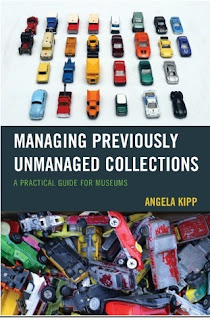
Reading List: Managing Previously Unmanaged Collections: A Practical Guide for Museums

Well look at me! I'm kind of so far sticking to this goal of reading through my pile of museum books to read! *pat on the back*  And now I'm back with another review!

I'd been reading Angela Kipp's blog "Registrar Trek" for a while, so I was really excited when she announced she was writing a book, and then again when she said it was being published. Her blog about the life of a registrar/collections manager was insightful and full of thought (well-written and thought out, as well "Huh, I never thought of that before. That's an interesting thing to keep in mind" thoughts), and often funny and crazy (Pictures of her driving a forklift always kind of scared me: "Do I need to learn how to drive a forklift to work in collections?!?"). So when her book came out, I immediately bought it, but then like so many other books I buy, it got put in a pile of books to read, and then sat there... and sat there... and sat there (as I suffered guilt about all the other books I was excited to read and bought... too many books, not enough time). Over the years, I read a few sections of the book that were relevant to something I was working on at the time, but I have only now read the whole book, cover to cover, and now I absolutely wish I had read it sooner!

One of things I love about this book is that it's not only about how to tackle the objects in a previously unmanaged collection (If you work in collections, or in a museum/historical society where you have access to the collections, you know what we're talking about: objects everywhere, piled up haphazardly, likely not in protective housing, maybe dirty; if you're the one who works with the collections, you know there are no numbers, no tags, no paperwork... *shudder*), but it's about the mindset you need to do the work. And it's not a "Get in there and get to it!" mindset; it's about focusing your time, your effort, your sanity, and even about knowing when to step away. Kipp gives us an overview and reminders on page 1 that immediately set the reader up for this work:

  1. Think of the whole collection, not single objects.
  2. You are a collections manager, now think like a project manager.
  3. See the big picture, work in small steps.
  4. Don't be spellbound by numbers.
  5. You are not the white knight.
  6. You are not a collections management machine.

She also includes "Logical Exits," which to me at first seemed like a loser's way of thinking ("What? You can't do the whole job? You're going to give up?!?"), but after I read about them, I realized that they make sense: There's a very good chance you can't do everything, either because the project is so large or there's not enough time, and sometimes you also just need to be able to step away for the sake of your sanity. Kipp includes 4 logical exits in working with and cleaning up previously unmanaged collections, and provides the reader with how to recognize and plan subsequent logical exits. As someone who pushes herself to exhaustion sometimes because she doesn't want to look like a failure, I appreciate that Kipp points out the importance of knowing these logical exits, "points at which you will have the collection in a condition that allows you to leave it for the next lucky person to take over [or to just step away for a while]... the points at which you can stop without risking that everything you've done so far... was a waste of time" (xii-xiii). 

But the book isn't just about being in the right frame of mind. Kipp talks about how to first tackle the mess, documenting where everything was when you first saw it; how to begin organizing the mess; how to organize the room it's going to go into; storage materials; dealing with the board, volunteers, and budgets; and even about making personal, human connections with other collections professionals, people in other industries, and people in your community who might be able to help you or advocate for you. She doesn't talk about nitty-gritty details like how to number a collection or which CMS to use; she leaves those aspects for other books. Instead, she starts waaaaaay back at the very beginning, which few other collections/museums books do. The numbering system or the database you use comes after you've been daunted by the scope of the collection/mess, and Kipp's book is one of the few (actually, the only one that I've seen, but she does reference a couple of others) that helps you tackle that daunting mess. 


Managing Previously Unmanaged Collections book cover
Managing Previously Unmanaged Collections: A Practical Guide for Museums, 2016
Angela Kipp
173 pages


The upsides:

  • This gives an overview of how to tackle collections messes, with great ideas of how to get started and the early steps you need to take.
  • Logical Exits that can keep you sane or give you "a goal toward which you can work" (172).
  • This book isn't just useful if you're starting at Square One. It's also good if you have some amount of organization and cataloguing, and her tips are useful even if you're decently organized and catalogued.
  • Her writing and the included horror and success stories make you feel like you have a friend in this work and you're not alone. Others have been through similar issues and have lived to tell the tales. 
The downsides:
  • I want a collections job even more now! I have so many ideas of how to jump in and get a mess under control! 

Overall: Yes, yes, read this! If you have the good fortune to work with a messy and unwieldy collection, you should read this book. If you have the good fortune to be the only person working with a messy and unwieldy collection, or you'll be leading a group that will work with the collection, you definitely should read this book. It won't give you all the answers, mainly because every situation is different, but it will give you a starting point, a healthy mindset, and plenty of good advice. 

Monday, September 20, 2021

Reading List: Active Collections

Hey! It's me again! Back with another book review!


I first heard about Active Collections, edited by Elizabeth Wood, Rainey Tisdale, and Trevor Jones, at a few of the virtual conferences I attended last year, and then later by a Collections professional who spoke to my Museum Studies class in the spring, and every presentation that centered around "We read Active Collections and incorporated it into our work" was absolutely eye-opening to me. The way the presenters spoke about the book and their new ways of working based on it was just... against everything I'd learned doing collections, but sounded so groundbreaking and inspirational. I was both aghast and intrigued. 

To start, essays here come from a range of disciplines, not just collections: there are historical aspects, psychological ("Why do we hoard? Why do we find it difficult to get rid of things?"), decolonization, consumerism, climate change... some things you might have realized on your own and things you might have never thought about before.  

The foreword prepares you that the essays will show how the field is "rethinking collections issues" and tells the reader that "we need flexible and practical solutions to managing collections" (xvii). And some of the rethinking is also reimagining and re-envisioning, and really does need to include a warning: there are some really creative and new ways of rethinking how to use your collection, including making objects available for being disassembled and studied or used to create new pieces of art. ("What?!? You want me to let people take apart artifacts?? You want me to give them away?? Are you insane?!?") But the whole point is if you have these objects, but you're not displaying them or using them to teach your audience, or they're not in good enough condition to display, then they're just stuff taking up space in some room that no one will ever see. And we have too much Stuff That No One Is Seeing Or Using, and it's costing us money and hurting the environment, so it's time to rethink what we do with that stuff. 


The upsides (including my favorite essays):
  • "Tier Your Collections: A Practical Tool for Making Clear Decisions in Collections Management" [I loved this! A how-to for prioritizing your objects.]
  • "Object Reincarnation: Imagining a Future Outside the Permanent Collection" [Freaky ideas! Totally go against our traditional thinking about preserving objects]
  • "Do You Know What It Costs You to Collect?" [Use data and hard facts of money and budgets to show that we can't save everything!]
  • "Hoarding and Museum Collections: Conceptual Similarities and Differences"
  • "The Vital Museum Collection"
  • "Activate Your Collection: 51 Questions to Reveal Inactivity"
  • A number of the essays talk about the meaning of objects and trying to document their meanings. ("What?? Document meanings?! How?!? And that doesn't fit into our current dimensions/material/creator scheme of record-keeping!")
  • I really liked the ideas a few of the authors had about having community/communal collections, working with other museums or organizations so you're not all collecting the same thing. Does each museum in the county need a 19th century tea kettle, or can just one have it and loan it to the other museums when they need a 19th century tea kettle to display or photograph? Of course, with that comes the implication that we're in contact with a network of museums, whether that's the museums in our community or museums that have a similar focus to ours. So these new methods of collecting and managing collections will require new ways of working, both within and outside of our own organizations... but that's kind of an invigorating idea, too! 
  • I also tried to incorporate some of these ideas while cleaning/reorganizing/downsizing this summer: "I don't know the provenance of these posters (Where did I get them? When? Did someone give them to me? What's the story behind them?) and they're 10-year-old schedules of sports teams, so do I really need to keep them? Nope, recycle." "Do I *really* need 4 of those mugs from a drink-mix product?" (Okay, I failed at getting rid of the extra mugs [so far] because they're so adorable, but I at least thought about it!)

The downsides:
  • So many bad habits to break! Wait... that's not a downside of the book; that's a downside of me!

Overall: I really appreciated this book -- the essays have so many new and good ideas, and eye-opening ways to look at collections, collecting, how we interact with our audiences, and how we let our audiences interact with our collections. 

Envisioning overcrowded and overflowing collections storage spaces, and thinking about statistics that say museums only display 2-10% of their collection, we know that our collections need help, and that our collections management practices need to be retooled. We can't accept every item offered to us, and we can't keep every item for all of time. We have to say no, we have to deaccession, we have to find creative ways to make use of the items we're not using; we can't keep doing things the way they've always been done. Otherwise, we're going to drown in seas of archival storage boxes. 

In theory, I'm on board. Rationally, I know we can't care for Everything Ever: weed out items, keep a few examples but not every example, keep the collection relevant, etc. When I try to imagine actually doing it, though, my scenario goes to "But I like having one of everything! I like seeing the evolution of objects!" If I'm ever in a position again where I have control over and responsibility for a collection, I'm going to take the advice and tips in Active Collections to heart, but I'll have to go through a deep-in-my-soul process of breaking some habits. 

Saturday, August 21, 2021

Reading List: Creating Exhibits That Engage: A Manual for Museums and Historical Organizations

This book is described as a "nuts-and-bolts guide to how to do [exhibits] step by step." It's meant, as Graham Black says in the Foreword, to help build the skills base of staff and volunteers at small and medium-sized museums and give them "the confidence to experiment and innovate" (xv). Author John Summers says this will give you "a method and a process you can follow that will greatly increase the likelihood that you will be able to create [a good exhibit]" (xix), and that 

If you want to know what is involved in making exhibits, this book will show you the scope of a typical project. If you need to create an exhibit, the steps outlined here will lead you through from beginning to end. Even if you are just hiring contract professionals to create some or all of an exhibit, the information in this book will help you to understand their perspective on the project and lead to a more effective working relationship. (xx)


Creating Exhibits That Engage: A Manual for Museums and Historical Organizations, 2018 by John Summers, 190 pages


The upsides:

  • A "nuts-and-bolts guide to how to [create exhibits] step by step that is suited to the resources typically available in small- to medium-sized institutions" (xix)
  • Each chapter has what Summers calls a "checklist" at the end, basically a summary or a TL;DR.
  • I really liked the section on how to create an Exhibit Brief

The downsides:

  • I felt like this was a very broad and brief overview of exhibits (The Big Idea, layout, fabrication, etc.).

Overall: 

Given all the summary information about how this would empower small museums' staff and lead them from beginning to end of an exhibit, I just didn't get it. The chapter titles and subheadings (Audience, The Exhibit Development Process, The Big Idea, The Brief and Request for Proposals, Text, etc.) sound like this would be a great resource, but I still felt like this was just skimming the surface. This felt like it was general guidelines and not like we're actually going anywhere big or specific. If you go with the statement above that talks about "the steps outlined here," then I guess it succeeds: this is just an outline of steps, which may give you a general map of how to create an exhibit, but doesn't give a lot of tips or advice on how to make it good. All of the other reviews of this book (which, granted, I couldn't find many of) think this is a great book, so maybe I'm just so uncreative and un-exhibit-minded that this book didn't touch me. There were some helpful parts, though, so this wasn't all a waste: a few accessibility guidelines, installation/viewing height guidelines, font samples, tools you need to build your own exhibit furniture (which is way beyond anything I'll ever do), and other tips, plus the Exhibit Briefs section was great; I just didn't see it as the same wonderful resource other reviewers did. I may refer back to it at some point, but I'll definitely look for other books about creating exhibits. 

Saturday, March 20, 2021

Reading List: Community-Based Exhibition Model by Cassie Chinn

Long ago, when I first really started getting into the idea of working in a museum, there was a post on LinkedIn asking for recommendations for good books about exhibits. One of the books listed was Community-Based Exhibition Model from the Wing Luke Museum in Seattle, so I put it on my list of books to read someday (although I couldn't find it for sale anywhere).

This past September, I attended the American Association of State and Local History's virtual conference, which had a number of staff members from the Wing Luke Museum presenting sessions. In their sessions, Cassie Chinn and Rahul Gupta each touched on the idea of partnerships with the community, and in other sessions, both from presenters and attendees, the Wing Luke's community-based model -- the book, and the general idea -- were mentioned. That made me want the book even more.

In October, Jessica Rubenacker, current exhibits designer at the Wing Luke, spoke to one of my Museum Studies classes; I LOVED listening to her, which made me decide I Need This Book Now. I was finally able to find it for sale on the museum's website (why didn't I ever look there before??).

In this short book (26 big-sized pages, with charts and images), Cassie Chinn describes the museum's process for creating their community-based exhibits, where museum staff let community members guide the development of exhibits -- including themes, education and public programs, sources for artifacts and interviews, and even fundraising -- and uses the 2005 "Sikh Community: Over 100 Years in the Pacific Northwest" exhibit as a case study for their approach.

The upsides:

  • The chart of the community-based model, showing how the Community Advisory Committee, participating community members, museum staff, and contractors all relate to each other and work together. 
  • How to select Advisory Committee members and community partnerships  
  • The meeting schedule - Chinn lays out what topics are covered at each of their (sample) meetings (Meeting 1 is introductions, sharing project background, presenting a timeline; Meeting 4 is creating the exhibit's storyline; etc.)
  • How to facilitate a meeting with the Advisory Committee, a lot of which are just good points for leading any kind of meeting (making sure everyone's voice is heard, sending meeting minutes, respecting people's time, etc.)
  • The Sikh exhibit case study shows in more detail how the theoretical model and timelines presented earlier in the book play out for real
  • The honesty about what worked and what got the Sikh exhibit project off schedule
  • The honesty about challenges presented overall by this model 
  • In the AASLH sessions as well as sessions of the New England Museum Association's virtual conference on working with the community and partners, over and over panelists talked about being flexible, giving up control, and admitting that you don't know everything, and these key points are also highlighted in this book. 

The downsides:

  • I would have liked maybe one more case study. The Sikh exhibit study gives good insight, but a second example could have possibly presented even more highlights and lowlights (things that worked and things that didn't) that the reader could learn from, and could also show how the museum learned from the challenges of the Sikh (or a previous) exhibit. Then again, this book was written soon after the Sikh exhibit was completed, so perhaps if they had an updated version, there would be more projects available to use as case studies.

Overall: A good tutorial for people who want to create exhibits with their community. The Wing Luke obviously has a great connection with their community and partners (otherwise they wouldn't want to help the museum with their exhibits), and Chinn does a nice job of presenting the framework for a community-based project.

Community-Based Exhibition Model book cover
Community-Based Exhibition Model
by Cassie Chinn


Sunday, April 19, 2020

Reading List: Volunteer Management 101: How to Recruit and Retain Volunteers by Allen Madding and Dan King

A few weeks before COVID-19 became so widespread in the Seattle metro area that businesses began closing their doors, the Education/Volunteer Coordinator at the museum I work at took a job at a different museum. To fill his position until a new coordinator could be hired, a number of our staff members took on various parts of his job, and the Volunteer Coordinator responsibilities were given to me (Yay!).

Fast-forward a short two weeks, and our museum closed “out of an abundance of caution” to protect the employees and public from the COVID outbreak. With a new – albeit temporary – role at the museum, and unexpected time on my hands, I took the opportunity to pile up a bunch of volunteer management books that I’ve been wanting to read.

First up is Volunteer Management 101: How to Recruit and Retain Volunteers by Allen Madding and Dan King.

This is a tiny book, and an extremely quick read. This is like the introduction to the introduction text on volunteer management. If you’ve managed volunteers before, been around volunteers before, been a volunteer before, have common sense, or have read or are planning to read probably ANY other volunteer management book, this one isn’t necessary. It’s got great tips, but stuff that should come up in most other volunteer management training or books.

That said, if this IS your first time managing volunteers and you need a quick book to get you up to speed, this is a fine one to start with. It’s super short, has bite-size pieces of advice and guidance, and will give you enough of a start until you need to get a bigger book to cover meatier topics.

I will say that even though a lot of what Madding and King say is old hat for experienced volunteer managers, there are some good quotes and inspiration, things experienced managers might have forgotten if they’ve gotten jaded or complacent in their jobs. A lot of it is commonsense, but nice reminders.  

The upsides:
• Some good quotes and inspiration, things to keep in mind
• Easy to skim for later reference  

The downsides:
• Example scenarios can be too long
• Grammatical and spelling errors! There aren’t really that many, but they still made me twitch.
• Some chapters are organized in a way that doesn’t completely make sense to me, and some chapters seem like they should be placed elsewhere in the book.
• Some reviewers online were bothered by the number of God/religion references. The authors are volunteers/volunteer managers for different church groups, so yes, a lot of their references end up being about church. I don’t really have a problem with this, since this is where their experience comes from, other than going back to the previous point that their example scenarios can be too long. I don’t mind reading about their church groups and volunteering with them; I mind there being so much unnecessary text about their church groups and volunteering. Edit!
• Their “case studies” are also a weird mix of Bible stories forced into the “a good leader does…” mold. Once they analyze the passages and tell me why they’re relevant, okay maybe; but… get there, and get there faster. And was this even needed to begin with? (And still, some never seemed to get to a relevant point.)

Volunteer Management 101 cover


Volunteer Management 101: How to Recruit and Retain Volunteers, 2018
Allen Madding and Dan King
114 pages

Overall: Good advice for newbies, reminders and inspiration for others. A good starter kit for people who have never been in charge of volunteer management before, but for experienced volunteer managers, this isn’t one that needs to be read.