Sunday, March 29, 2026

Reading List: Developing Successful Grants: How to Turn Your Ideas into Reality

Awww, the good old days of the early 2000s :D 

In my defense, I just discovered this book this month, so this isn't one of those that I've had on my to-read bookshelf so long it's gone out of date while waiting for me to read it.

This is an insightful analysis of the process of writing grants, with lots of good ideas of how to go about the process, from first knowing what you need to fund then to finding grants, writing the application, using a Common Grant Application, preparing your budget, on and on. 

The book was written in 2005, so reading it in 2026 there are quite a few "tips" that are now outdated (like saving your documents to a zip disk, going to your local magazine store to purchase a phone list, and not submitting electronically); however, overall the advice and process is still relevant and helps you avoid pitfalls. 

The Upsides:

  • Start with taking an inventory of your needs - program needs, equipment, etc. Once you know those things, then you can begin looking for funding. 
  • They lay out the process in really easy to understand steps.
  • There is lots of advice and quite a few samples (samples of how to format goals vs. objectives in a table, samples of breaking text into bullet points to be visually appealing, advice on using emotional language, etc.).
  • They explain how to make the general layout they recommend match a funder's RFP or required layout.
  • They include what items/aspects you should include in your application, even if the funder doesn't ask for it.

The Downsides:

  • The age of the book. There were quite a few things that I thought, "Ooh! I didn't know about that. Let me go look it up," only to find a website that is for sale instead of having whatever it had in 2005, or the aforementioned tip of getting a list of funders at your local reputable magazine store. (There were also a number of suggested websites that I remember from long ago, felt nostalgic when reading about them, then was sad to visit their website and realize they don't exist anymore or not in the same way they used to.)
  • One thing they repeatedly highlight is having a group to work on grant applications, including people familiar with the program(s) being funded, a proofreader, a writer, someone to compile everything, community supporters, ... These are great ideas and would certainly help a grantwriter feel less pressured and stressed, but let's be real - how likely is it a small organization is going to have that many people available to help with a grant? Even if you recruit members of your community for some of these positions, you're still not likely to have this grand Team they recommend. But it's a nice ideal.

Overall: This is a really great look at the process of writing grants, and despite the age of it, it's still very informative and useful. I recommend this to people working on finding funding and preparing grant applications, especially people who are new to the role.  


Developing Successful Grants: How to Turn Your Ideas into Reality, 2005
Mike DuBose, Martha Davis, Anne Black, and Research Associates
230 pages


Reading List: Things Great and Small: Collections Management Policies (2nd ed)

Sometimes I'm so ashamed by how long books sit on my bookshelf before I read them. I see them in the store or online, I get really excited, I buy them, and then... I just don't have time to read them. I bought this book when it was new (2018) but didn't read it until this month. Yikes! At least nothing's too outdated yet!

This is a nice overview of collections management policies - different types of policies you should have, what you should take into account, why to have policies, who should be involved in writing or approving different policies, all that good stuff. It also includes topics like risk management, intellectual property, and ethics.

If you've read a lot about collections, collections management, and policies, there's nothing really new in here; but this is a great synopsis of collections management policies if you haven't read a bunch others, or a nice one-stop-shop of all the good stuff to get you going.

Plus, John Simmons is funny. If you're on any collections e-lists with him, you likely know his December holiday-themed/museum-management-themed poems. (I was disappointed, though, that the funny wasn't strong throughout. He starts off well, with sample policies from the House of Victoriana, the Institute of Contrafactual Science, and the Museum of Mediocre Art, but then some of their sample policies are just like regular sample policies and the funny is gone.)


The upsides:

  • A nice one-stop-shop of all the good stuff to get you going on your Collections Management policies
  • Good for newcomers to the Collections Management game

The downsides:

  • If you have other books about Collections Management, you might not need this.
  • There are a number of "When Policy Meets Reality" call-out boxes scattered throughout the book, but a lot of them seem irrelevant. They're funny or interesting or astounding, but they're not always helpful. If you try hard, you might force yourself to stop and think about what you would do if you were in that situation, but there's not a lot of insight offered. And others just make you think "Huh, that's... interesting" and you move on. It's some wasted space that could have either been used for more helpful info, or could have just been cut and made the book a bit smaller. Similarly, a lot of the images seem unnecessary, and removing them could have made the book smaller. (I keep saying "smaller" because it's a tall and wide book - 11" H x 8.5+" W)


Overall: This is definitely worth a read, unless you Absolutely Know Everything about collections management and policies. Even if you think you know a lot, you still might get some new insights. Or you might gain a new favorite reference book.


Things Great and Small: Collections Management Policies, 2nd edition, 2018
John E. Simmons
220 pages (and it's a tall and wide book, too), including references/bibliography/other reading, and appendices with AAM's Code of Ethics, AAM's Accreditation Commission's Standards Regarding Collections Stewardship, various laws and regulations that affect collections

Reading List: Getting Caught Up

Hey, I read a museum-related book! Lookatme! (Yikes). I'm trying to make more of an effort to read museum- or nonprofit-related books again (Didn't I say that before, too?), and this year I've read five already! ... Okay, some of it has been because it's been painfully slow for me at work lately, and I've had to create projects to keep myself occupied. One of those was finally reading a bunch of books our old Executive Director gave my then-manager when she retired and cleared out her office. My then-manager gave the books to me to store for our department, and now that I've had NOTHING to do, I decided it was finally time to read them!

Book #1 was The AAA Way to Fundraising Success: Maximum Involvement, Maximum Results, which I really learned about in a webcast I watched (DonorPerfect Community Conference 2025, Robbe Healey "Stay the Course: Individual Giving Tactics for Changing Times"). The book sounded useful, and the cover the presenter showed started to seem really familiar... and then I realized it was because it was one of the books our Director had given us that I'd been wanting to read! So I dove into it.

The book is super short but super useful. It helps you think about how to structure your organization's culture of philanthropy and how everyone can be involved. It's specifically focused on getting your board involved in cultivating donors and partnerships, but it can be applied to anyone. 

Kay Sprinkel Grace says there are 3 types of people needed: Ambassadors and Advocates to talk up your cause, make connections, and lay the groundwork, then the Askers who do the actual asking for a donation. She describes the function of each of the roles and explains what personal traits make for a good fit for that role, and also gives ideas of how the different roles interact and work together.

This was such a fantastic way to show that fundraising isn't only about asking for money; it's about getting the word out and building relationships, too. And we can all play a part in that. Someone may not feel comfortable asking someone for $$$, but can talk up the cause they believe in.


Book #2 was Asking: A 59-Minute Guide to Everything Board Members, Volunteers, and Staff Must Know to Secure the Gift, by Jerold Panas. This was a quick, easy-to-read reference book, yet it felt like it was giving you everything you need to know. He lays out the cultivation and solicitation process step-by-step, from identifying potential donors to writing an introductory letter (I'm not sure how much of that is still relevant today) and making an introductory phone call to having a first conversation (but not asking for money yet) on through to the Ask and follow up. Panas gives great tips, makes it all seem really easy, and even gives advice for when the donor says no or when you only think they've said no. Like The AAA Way to Fundraising Success, this would make a great reference book to have handy to keep fundraisers on track and motivated.


I'll mention book #3 for the year quickly because while it wasn't exactly useful, it was fun to read: The Principles Of Museum Administration, George Brown Goode's 1895-ish treatise of the workings of museums (reprint purchased on Amazon). It was really interesting to read as a historical record of how early museums in the U.S. were perceived and run, and how much of what he wrote is still relevant today!

I originally hadn't planned on writing about The Principles of Museum Administration because it was so short, and hadn't even thought about writing about the fundraising ones, in part because I've been reading them at work (different environment, so I didn't make the mental connection between reading and blogging) and in part because they're not museum-related. However, museums obviously need to fundraise, so even though these books aren't about collections or exhibits or other museum-specific areas, they are relevant to museums. 

So there you go! Museum- and nonprofit-related books I've been reading in 2026. I've got two more that I've finished reading recently, so stay tuned for those reviews!

Sunday, October 19, 2025

I'm Still Here!

 Hi again!

I realized it's been a little while since I'd posted here, so I popped on over to see what the last thing I wrote was... AND IT WAS FROM JULY, 2023! 

When we last talked (or I last wrote, and hoped you were reading), I was posting about museum books I was reading and about some unidentifiable photos I found from my grandfather's time in the Air Force. I had plenty of time to read, and research, and write about what I was reading and researching because I didn't have a job.

But then I got a job! Woo!  It's not related to the history field or museum activities that I read about, but it is in a museum/nonprofit, so I'm kind of close to the sector I was hoping to be in. 

This doesn't give me a lot of time to read many, many museum books (or any books) and write reviews, though, and I've fallen behind on my research on my grandfather's history. Plus, I started going down the rabbit hole of USAF research: in order to know when and where some of his photos might have been taken, I decided I needed a better idea of where he was stationed and when. I went through my old files and dates that I'd gotten from my mother years ago, but decided they weren't detailed enough, so I went through ALLLLLLLL of her files again, made way more notes, started to put together a better timeline.  ... And then I realized there were a bunch of phrases and abbreviations in his paperwork that I didn't understand, and Air Force bases I didn't know, so then that became another layer of research.  So while I haven't found any new leads or concrete answers on those photos or any of the other photos I found while going through my mom's genealogy files for the hundredth time, I'm attempting to broaden my knowledge of the military, specifically the Army Air Corps / Army Air Forces / Air Force in the 1940s. 

One cool thing I did find was a yearbook from my grandfather's Training School at Mather Field from 1942. Similar to your high school yearbook, it gave an overview of the campus, talked about activities the incoming cadets had to go through (think about your Freshman orientation), classes and training that the different ranks went through, and had pictures of these classes and the individual servicemembers (!). There's my grandfather, age 20-ish, a young man just starting his career! Oh my goodness!!

The few times I get to spend time researching my grandfather's career, it is in the back of my mind of how I could articulate it in a blog post, so I do still think about you! And the few museum books I've read since July 2023 haven't been super awesome and worth going back to review -- either good or bad -- but I did kind of forget that I'd been reviewing them (Sorry). So that said, I do still think about you, I just didn't realize it had been so long since I posted, and I don't have the same kind of time that I used to have to spend reading or researching things that are worth writing about :(  But I do still exist, am still trying to research those photos and my grandfather's military career, and I am still reading (when I can) books about different aspects of museums. I'm still here!

Sunday, July 30, 2023

Reading List: Registration Methods for the Small Museum

book cover of Registration Methods for the Small Museum
Well... I just don't have much to say about this one. I usually have lots to say about nearly every book I read, but this just wasn't one of them. And I don't know why. 

It's a fine enough overview of registration needs, methods, policies, forms, etc. It's the kind of thing you could give to someone NEW to collections and registration (a new volunteer, or someone running a museum starting their Collections department, including procedures and policies, from scratch), and it would give them the very basic knowledge about why we do things and how to go about doing them. But it was dry at times (most of the time?), and just... so basic and factual that there was no pizzaz or pah! to the book. It was just "Here it is. Just the facts, ma'am." Even the author's first-hand anecdotes were just blah.


The upsides:
  • It has the very basic info, including the What, Why, and How. 
  • Sample forms and policies
  • It has a good chapter on using computers for your collections - what to look for in software, security, hardware, and networking. Again, just basics, but enough ideas to get you started.

The downsides:
  • It felt boring. I mean, okay, maybe some people wouldn't find this kind of thing interesting or exciting in the first place, but you and I do, right? That's why we're here, writing and reading this blog post. So for *me* to say "Eh, it's dry" says something.

Overall:
I feel like there are other books covering the same info, and more in-depth, but if you just want a Basic "How and why we do this," this would work. And that type of book absolutely has a place and an audience, but if you've been doing this for a while, or want something less snoozy, maybe look for another book. I'd still give it 2.5 or 3 stars out of 5, though: a nice middle-of-the-road, did-what-it-came-here-to-do rating.


Because I feel like I'm so down on the book and not doing a good job of explaining its value, here's the Table of Contents, so you can see that it *does* cover useful topics:
  1. Why Have a Museum Registration System?
  2. Acquisition
  3. The Accession Number
  4. Accessioning
  5. Documentation
  6. The Catalog
  7. Loans
  8. A World of Computers
and then sample forms and policies.


Registration Methods for the Small Museum
, 2018
Daniel B. Reibel, updated by Deborah Rose Van Horn
105 big pages of text, 33 pages of samples, and a bibliography

Saturday, March 18, 2023

Reading List: Recording Oral History: A Guide for the Humanities and Social Sciences, Third Edition

book cover for "Recording Oral History" third edition
One of my favorite types of projects for museums is transcribing oral histories and interviewing people about their lives. Mostly I do transcription, but for a while I was also interviewing a certain group of people. Between hearing over and over one particular interviewer whose style I didn't particularly care for, and wanting to maybe do more interviews myself (while not wanting to sound like the interviewer whose style I didn't care for), I decided to expand my library to include books about oral histories. 

Valerie Raleigh Yow's book is a really great overview of oral histories, and possibly answers every question you might have about preparing for an interview, conducting the interview, what to do after the interview, and how to use the quotes and information you get. 

Yow starts at the very beginning of the history of oral interviews and passing down information orally, which made it seem like the book was going to be dry and boring. (A good portion of each chapter is bibliography/other reading and notes/citations, which also made it seem like the book was going to be super long. This is a good-sized book, but when you take into account how much of it is reference material, it's much less daunting.) But then she gets into what we really came here for. 

Yow starts at the beginning of the interviewing process: asking what the purpose of your project is, who you need to talk to, what you want to ask them about, and whether they can give you names of other people to talk about. (You thought the beginning of the interviewing process was when you showed up at the interviewee's house? Wrong!) She also discusses interviewing techniques and strategies, legal issues and ethics, fact-checking, and getting a range of voices for your project.

Other chapters include topics like how to choose a recorder, work-for-hire (ethics, warnings, scope of work), chapters for those specifically doing family histories or community (not necessarily geographic) histories, and where to store your final product (accessible archives!).


The upsides:

  • Yow covers everything about an oral history project, from figuring out who to talk to, how to get additional people to talk to you, how to act around the interviewee, having an informal meeting with the interviewee to get to know each other before the real interview, cultural differences, ethics, having the interviewee read the transcript or your finished product, how to choose your audio recorder, transcribing, finding a repository, ... everything from your first "I have to do an interview" to your very final "It's done, has been used, and has been stored somewhere safe but accessible."
  • The bibliography and suggested reading at the end of each chapter. Yow breaks them down by topic, and tells why each resource is a good resource. 
  • Sample forms, questionnaires, and instructions.

The downsides:

  • Since Yow is writing for different audiences (the family historian, the public historian, the work-for-hire for a company project, etc.), she sometimes repeats information from other chapters. If you're reading the book straight through, you'll start to feel the repetition. But if you're only reading chapters that are relevant to your type of project, this is actually an upside: no matter why you're reading the book, you're going to get all the information you need.

Overall:

This is a great one-stop reference for all aspects of an oral history project. If you're spearheading an oral history project or the only one involved in one -- for a museum, community, school, or company -- I'd recommend reading this whole book; if you have others helping you, such as students or volunteers who will be less involved in the whole process, I'd recommend giving them portions to read, but not necessarily the whole thing. There's definitely something for everyone involved in an oral history/interviewing project! 


Recording Oral History: A Guide for the Humanities and Social Sciences, Third Edition, 2015

Valerie Raleigh Yow

406 pages, including sample documents and recommended reading

Sunday, February 26, 2023

Reading List: Museums 101 by Mark Walhimer

"101" usually implies a basic-level introduction to a subject: Sociology 101, Math 101, etc. Reviewers on Goodreads also refer to this as an introduction, either for themselves or for their students, and I came across it as a book being used in a Museums Studies class. As a very basic introduction to museums and museum management, this book is fine.

But, if you know nearly anything about museums, this book is not really for you, unless you just want it to skim, or maybe get a few ideas, or to have on hand to give to someone who is new to museums. If you've been around museums, you're not really going to get much out of this.*

And if you're new to museums, I don't think I'd recommend reading this unless you're reading it for a class and have a teacher to walk you through it. There are places where Walhimer doesn't really explain jargon he uses; there are places with mistakes (he refers to a 503(c)(3). I googled 503 instead of 501 in case a 503 is a less-common tax status that I have never heard of, and every result was for 501(c)(3)s. A museum newbie without a guide might be confused); and through the majority of the book, I felt like I was putting things together on my own, based on my experience, rather than him doing a good job of explaining them, their connections, or their relevance. 

* That said, there are some things I found interesting or things I didn't know or things to keep in mind for the future. But overall, eh. 


The upsides:

  • This covers a little of everything involved in museums: where to put your museum, creating exhibits, collections access, building an integrated atmosphere, ... on and on. 
  • Early chapters have "Next steps" at the end of the chapters (such as organizations to look up or a suggestion to visit a museum in your area). These are cool for those just getting into museums; I wish he'd continue them after those first few chapters, though. They can get your brain jogging on things to do or other institutions to visit for ideas. Granted, he includes a lot of examples of museums in most of his chapters, so you could figure out on your own what the "next steps" should be to research a topic further, but I wish he'd continued it for consistency and for that extra push of "No, really. I'm not just blowing smoke in the chapter when I name-checked that museum. Look them up!" (especially because a number of times it felt like it was name-checking of how great he is, or just how many different museums he could list).
  • Short chapters - he gives you only the very basic information.
  • He provides resources, sample documents, and additional reading. (The additional reading can come in handy for anyone who wishes that maybe this were Museums 102 or 103, and not 101.)
  • There's a website associated with the book where you can download the above resources (rather than just looking at the not-so-great-quality scan that's in the book) as well as some not included in the book.


The downsides:

  • Typos and mistakes! Some are little (quite a few times of missing words), some are ones that you can figure out but are still annoying (he refers to Telsa Motors and Telsa Museum in a paragraph; like the 503(c)(3), I googled these just in case there's something I'm unaware of, but no, every result was actually for Tesla), some are bigger but not relevant (Bill Gates wasn't the founder of Microsoft; he was the co-founder; but if I can't trust you to get that right, what else are you getting wrong? [see also Telsa and 503(c)(3)]), and some are more important, like claiming your organization can be a 503(c)(3). 
  • There are times -- especially when talking about finances -- that I think he's trying to give the reader a realistic picture of what it takes to plan and run a museum, but it comes across more as "Do not do this! You can't do this!" 
  • The index isn't very helpful. I found myself writing in a number of topics (like endowments), and although he mentions mission statements a few times, it's not listed in the index. He says in the introduction that you can either read the whole book, or just the chapter(s) related to your questions, but when topics like mission statement are scattered throughout, including in a chapter about a museum's physical building (!), but not in the index (!), you basically have to read the whole book to answer your question about mission statements. 
  • Some of the organization felt odd. Not only does he talk about mission statements in the chapter about the museum's building, but he also talks about background checks for board members in the chapter about collections care. I do see how these can be linked (your building should represent the museum's mission and tone; you want to be able to trust your board members with your collections [and finances]), but why aren't these in their own chapters? Or with a better index so you know to read the chapter about buildings if you want stuff about mission statements and the chapter on collections so you know to give your board members a background check! 
  • I didn't understand some of his charts and references.
  • Short chapters - in most cases, he only gives you the very basic information.


Overall:

Eh. It can't hurt for seasoned professionals to read this. It does include topics like building a culture at your organization, both an internal culture and with your audience; museum feasibility studies; project management; and a questionnaire to give artifact donors. So yeah, there's probably a chance even people who work in museums will find something new or memorable in the book.

For people new to the museum field, there are other books you can read. This does have the benefit of being sort of a one-stop-shop for very basic information about running a museum, but I don't know how useful it would really be to anyone starting out in the industry, since you'll find most of this information elsewhere and the book's writing and organization seem scattered. 

The writing also felt outdated, even though it's from 2015 and does include current topics like sustainability. Other places felt like he was writing about the old way of thinking of museums, though, like pay, treatment of employees, things like that. 

If you know about museums already, don't waste your money buying this. If you really want to have it as a resource, look for it at a used bookstore or someone cleaning out their library. 

If you don't know about museums already... there are other places to find enough of this information that I would suggest you not waste your money, either. Check it out from a library, instead! 


Museums 101 book cover

Museums 101
, 2015

Mark Walhimer

160 pages of text, 50 pages of sample documents (14 documents), approximately 5 pages of Bibliography

Wednesday, January 25, 2023

WWII Planes: Follow-Up and Thoughts

As I read Dave's comment on my "You Are My Sunshine" post about the California Sunshine possibly being too worn-out to take when its squadron moved, I started to have more thoughts about these planes. I've had this thought before, but had it again as I'm researching these individual planes: it's really a shame when these amazing aircraft are scrapped, re-used, or just abandoned.

For one, think of the history of these planes: How many people worked on assembly lines to make this specific plane? How many hours did it take to build it? How hot and sweaty were the factories? How many people had to learn new skills to build it? What did the people who built this specific plane talk about on their lunch breaks? What did they eat for lunch? Who packed their lunches for them -- wives for the men, themselves or roommates for the Rosies, themselves for single men? -- and what were they thinking about when they packed the lunch for that day? How proud were the workers when the plane was finished and rolled out the hangar doors? What were the life stories of the men who flew it? Whose head(s) would have been visible in the cockpit? (Look at the picture again -- Can you imagine them there?) What did the maintenance crew members think about while working on its day-to-day routine? "Tighten this screw"? "I miss my wife"? "I wonder how big my kids have gotten"? "What's for dinner tonight"? 

Then the plane itself: This huge, massive thing that worked on amazing rules of physics that most people don't understand; this loud plane that rumbled through the sky and could bring feelings of pride, fear, or hope; this metal tube that was the everyday work office for some people... 

And the art! What a shame to just leave our California gal to rot! And for the artists who did the art on planes, how did they feel about the fates of their work? Did they wish they could take it with them? Did they wish there was some way to transfer the art of the plane, either to another plane or to a canvas or a photograph? Or were they so talented that it meant nothing to them to leave something behind (which is something I often wonder about people who are artistically talented)? 

Looking back at my grandfather's picture (?) as I read Dave's comment, I felt immense sadness. That junky-looking plane once was majestic, mighty, shiny, and full of hope and potential... and now she's just broken down and left behind. 

*sniffle*

Reading Dave's comment also made me wonder more about where/when my grandfather was stationed, so I decided to Google his squadron.  (Note to self: try to Google his different units again. It's been a while since we've done this.) One of the results listed one of the airfields mentioned in my research of the American Beauty; I don't know what that means for me, but it was noteworthy in my head. If nothing else, it's "Hey! I know that name now!" and "Everything's related!"

And then I had another "Everything's related" moment: a site suggested that P-38s might have been one of the planes my grandfather was in contact with while he was in the South Pacific. I'm transcribing an oral history this week, and the interviewee (who is also someone I've worked with in the past) talks about his family living near Lockheed's P-38 factory in WWII and his father building P-38s... Wouldn't it be wild if my grandfather worked on or near a P-38 that the father of a man I know in-person helped build? I know that's a stretch, but wouldn't it be mind-boggling?!? 

So now I obviously have more research to do: researching each of my grandfather's units with the rough dates he was in them to see if there's new or additional information out there (using trusty Google, but also Library of Congress and the National Archives); going back through my mother's files to see if there's anything about what types of planes my grandfather worked on (I remember a transcript or something showing the different type of maintenance he was certified for, but was there anything that listed the types of planes he was certified for, or had worked on?); ... and I'm sure more stuff will come to mind as I get to work.

All of this research makes me wish again/more that my grandfather was still around. Looking at his photos and then doing the research has brought up so many questions for me! Formerly working at a museum of WWII planes always made me wish I could talk to him and ask him stuff; and the location of the museum (being on the same base he was once stationed at) brought up questions every day. I wish I could ask him all of these things, or just talk to him about his life and service. 

Friday, December 30, 2022

WWII Planes: You Are My Sunshine


wreckage of WWII airplane "California Sunshine"
Not-so-shiny
California Sunshine

Next in my pile of possibly-WWII era photos we have California Sunshine. Like I said in my introduction post, this one had a couple of groups of numbers, so I started with the one that looked most like a serial number: 42-86776. The Google bot returned a hit on Forgotten Props. This site told me that this is a Douglas A-20G-20-DO Havoc. Wow! So the top group of numbers on the plane is the plane’s model number? I don’t think I’ve ever seen that before. (After looking at an unrelated picture of a P-51 from a museum a few days later, Hey! It’s got its model number on it, too! So I guess I should just look closer for these things, or pay better attention.) 

Strangely, though, Forgotten Props was the only site that gave me any information for that serial number, which perhaps shouldn’t have been surprising, considering the site says “Construction #: N/A” and “Information Needed” (Not even my new friend Pacific Wrecks had any information about this specific plane, or even included it in the listing of A-20 Havocs, which includes planes that were scrapped or abandoned, not just ones that were wrecked. Nor did this site have this, which lists a ton of airplane serial numbers. Why is this serial number unaccounted for? Mystery!). However, when I did the serial number + the nose art, I got one hit: this plane was assigned to Maj. William H. Kemble, Jr. of the 312th Bombardment Group. This also matches fuzzy details in the picture: under the serial number, there’s white lettering that – as best as I could read, with my eyes, two different magnifying glasses, and blowing up the scan – says “PILOT MAJOR W. H.[?] [ ],” so Major William H. Kemble, Jr. would work (and now that I know what it might be, and looking at the physical picture again in the morning with daylight and fresh eyes, yes, that’s absolutely what my picture says). I tried searching by Major Kemble’s name to see if I could find anything about the fate of this plane; all I found was that in December 1953, he crashed, with minor damage, a C-45 with serial number 44-47659. 

The fuller description of the book this information about 42-86776 comes from says that this bomber group was stationed in the South Pacific, flying combat missions from New Guinea, so again we have that South Pacific connection with where my grandfather was stationed. The 312th Bombardment Group originally flew P-40 dive bombers, but “quickly converted to the A-20 light attack bomber and fought its way across New Guinea, the Netherlands East Indies, the Philippines, and Formosa. Many of these missions were flown in the low-level strafer attack mode.” (Later in the war, the 312th switched to flying B-32 Dominator Very Heavy bombers, if you’re wondering.)  

Pacific Wrecks says that serial number 42-86786 was delivered to the U.S. Army Air Force on September 1, 1943; with this being 10 serial numbers after my California Sunshine, can I assume that my plane was delivered to the USAAF around the end of August or beginning of September 1943? 

Douglas A-20s were light or medium bombers, attackers, and night fighters, and were used by many countries’ air forces. A-20s were called either “Boston” or “Havoc,” depending on the type and whose air force they were in. Most of the U.S.’s A-20s were used in the South Pacific. Joe Baugher says that “most [A20] sorties were flown at low level… . During these low level bombing operations, it was found that there was little need for a bomb aimer. Consequently, the bomb aimer was often replaced by additional forward-firing machine guns mounted in a faired-over nose. The A-20's heavy firepower, maneuverability, speed and bombload made it an ideal weapon for pinpoint strikes against aircraft, hangers [sic], and supply dumps. In formation, their heavy forward firepower could overwhelm shipboard anti-aircraft defenses and at low level the A-20s could skip their bombs into the sides of transports and destroyers with deadly effect.” The Aviation History Online Museum says that A-20s were “said to be easy to fly with good handling characteristics during takeoff and landing. It represented an advance in flight control systems with light handling during high-speed flight… The tricycle landing gear made takeoff, landing and ground handling very simple and pilots were able to fly it with a minimum of instructions.” The modifications for the A-20G “optimized [it] for low altitude attacks,” but “such low-level torpedo attacks were quite dangerous for the A-20s which were vulnerable to anti-aircraft fire, [however] the success of such operations outweighed the risks”

A20-G planes were the most produced of the A-20 series: over 2850 were built. The plane had a wingspan of 61’, was 48’ long, and about 18’ high; it carried two to three crewmen; and could travel 325-340 mph maximum. 

The final A-20s were delivered in September 1944. After the war, Baugher says, “the Havocs and appropriated Bostons had become surplus to USAAF requirements, and most were immediately scrapped. However, a few surplus Havocs were offered on the surplus market at very attractive prices--only $3000 apiece with a full tank of fuel. Nevertheless, the A-20 never became very popular on the civilian market.”

Rampage of the Roarin’ 20’s: The Illustrated History of the 312th Bombardment Group During World War II describes the original paintjob of A-20s: “The standard A-20G camouflage, applied at the Douglas Aircraft Corporation plant in Santa Monica, California, was Dark Olive Drab upper surfaces with Neutral Gray undersurfaces.” The book also includes an image – I think an artist’s rendering of the nose art – of the airplane that shows our California gal in a maroon dress with white underskirt, thigh high nylons with her thighs showing above her garters, white collar and wrists, a maroon hat with white band, with her image surrounded by grey and holding something… a parachute or a feather duster? “California” is in yellow with red borders, and “Sunshine” is either in all yellow, or with a very thin border. And still, the airplane itself is a dark olive drab. 

U.S. Army Air Force Douglas A-20G-20-DO (S/N 42-86657) in flight, via Wikipedia

Douglas A-20G Havoc at National Museum of the United States Air Force, via Wikipedia

I count at least 40 bomb markings in my picture, most of which look like they include another marking (a star?) above the bomb; if this plane had presumably so many missions and successful missions, why can I not find anything about it online? Especially given how much I found about American Beauty! That is a huge mystery. 

So was this plane about to be scrapped when my grandfather (possibly) saw it? Where and when was this? Since I can’t seem to find any records of what happened to this plane in its career, I have no idea. (And honestly, I’m a little disappointed by the internet right now. You start out not expecting to find any information, but once you start to see how much information, overall, is out there, you suddenly expect everything to be accessible. Why is there so little information for California Sunshine?) 

One last thing: underneath the pilot’s name in the picture is what looks like more writing, possibly “PROJ. 96344” or “PROJ. 9634-J.” I searched the internet with a variety of search terms, including other numbers I thought it might be (for example, not being completely sure that was a 9 and not a 2), and the only result I got was one A-20G Havoc, serial number 43-9106, with “PROJ. 96344” stenciled on it. I also tried googling that number with combinations of “USAAF,” “US military,” “WWII,” and still only got this one result. So… is it a project number of some sort? And if it’s on two planes (California Sunshine and Short Stuff), why isn’t it on – or noted online – other planes? And this serial number is a fair way away from Sunshine’s, and the plane is an A-20G-25-DO, so it doesn’t seem like this “Proj.” implied a specific production line. I don’t know. Anyone out there know anything they can share with me? 

So, feeling a little underwhelmed with the information I found on our California Sunshine gal, I move on to the so-called “Zero.” 

pt3: WWII Planes: The Mistaken Identity of Oscar or Zero

WWII Planes: What a Beauty

Portions of WWII airplane named "American Beauty"
American Beauty airplane

First of my WWII airplanes to look up is American Beauty, and her toplessness. There’s no serial number on this plane visible in the picture, so all I had to go on was the artwork. I was quite surprised when this turned up a lot of information. First, I found this plane on a few people’s Pinterest boards. I know nothing about this plane – or military aviation history, really, other than the very significant planes – so it’s wild to think that my grandfather saw the same plane that other people have seen and posted/published pictures of. It’s one of those moments of “Wow, my family witnessed history, stuff other people cared about, too!” 

Another search result gave me a serial number: 42-73045. The page had a brief, but extremely fruitful, history of the plane and a couple more pictures. Woo! Making progress! 

This page tells me that the American Beauty was converted to a photoreconnaissance F-7A and flew in New Guinea and the Netherlands East Indies in 1944, then was scrapped at Nadzab Airfield in New Guinea. From my grandfather’s service records, I know he was in the South Pacific for part of 1944, and the condition of the plane looks pretty awful – implying it might be scrapped soon – so things are matching up. I wonder if my grandfather saw this plane as it was in the process of being scrapped. I don’t have anything that says he was stationed at this specific airfield, though, so I don’t know if he was there and saw it on a daily basis, or if he was just passing through. 

(These two sites explain how a B-24’s bomb areas (bomb bays, bomb doors, sights) were reconfigured for cameras and camera sights in an F-7A, if you're curious.) 

So to the googlemachine I went with this serial number the Pacific Wrecks site gave me. Most of the hits had similar information, if not the exact information, but one document I found in a couple of places that I loved had a picture of the 7/18/44 20th Mapping Squadron, 6th Photo Group crew and a typed/scanned list of all of their names. Could you imagine finding that if your father or grandfather was one of those people listed? I know my grandfather wasn’t part of a Mapping Squadron, but I still held my breath as I read the names, just in case. 

Finally, I searched the Library of Congress and National Archives websites using the plane’s serial number, name, and/or a few other bits I found while looking at all of these other records. LoC didn’t give me anything; the Archives gave me no results using the specific information, and I didn’t feel like going through the 41,000+ results for “B-24” and 1,827 results for F-7A in the 1940s (although the ones I looked at were amazing. They are so clear and the captions are so detailed.). Yikes! 

One thing I was confused about were the markings under the window. (For one, they look like flower pots to me.) As far as I know, marks like that usually represent bombing missions, but if this plane was only used for photoreconnaissance, there wouldn’t have been bombing missions. Two grainy images I found online also have these decals (one only has one row of decals, but the other has the exact set of decals my photo does; other clues tell me that if my grandfather’s picture was of the plane on its way to being scrapped, this other photo looks like it’s even further along in the process). For a moment, I thought maybe it represented how many missions the plane had gone on (but why do some have stars and others don’t?), but there are 12 of these flower pots, and websites I found say it went on 19 missions… yet others say it was shot down on its 12th mission. Hmmm… 

So to solve the first: The Mystery of the Mysterious Flower Pots. Two websites about the 20th Mapping Squadron briefly noted these markings! According to Bill Cahill and Chuck Varney, these are mission markers, but they’re not flower pots, they’re K-17 aerial cameras (Really? Okay… maybe.). A star above a camera [flower pot] represents a successful mission (whereas clouds would mean failure due to weather, an X would mean mechanical failure, and “C.F.” would mean crew failure), and flower pots – I mean, cameras – without a star meant a non-successful mission (perhaps due to weather, mechanical, or crew issues, but not wanting to draw attention to the non-success). 

Mystery #2: The Mystery of the Missing 7 Flower Pots. This one, I don’t know. The main discrepancy is whether the plane went on 19 missions or was shot down on mission #12. Could it have been shot down and damaged, seen by my grandfather and the other photographer, reconstructed, and gone on 7 more missions? And/But if it did, why wouldn’t those extra seven missions be denoted by flower pots, too (unless, again, my grandfather and that other photographer saw it between missions 12 and 13… but that seems unlikely)? 

A final note on American Beauty: a few of the sites I found say the artist is Al G. Merkling. Merkling was a Corporal in the 20th Mapping Squadron and did most of the squadron’s nose art. 

I’m sure there’s a ton more information that I could try to find, but I’m happy with what I have on this one now: it was built in 1942 as a B-24J Liberator, but was converted in 1943 to a photoreconnaissance F-7A; serial number 42-73045; artist Cpl. Al Merkling; it flew (19 or 12) missions around New Guinea in 1944; and was scrapped in New Guinea at Nadzab Airfield in 1944, around the same time my grandfather was stationed – as military records like to say – “somewhere in the South Pacific.” If I want to go further in-depth, I also now know what changes were made to a B-24J to make it into an F-7A for cameras, and I have names and pictures of some of the men who flew the 42-73045 and other planes in the 20th Mapping Squadron. What I still don’t know is whether my grandfather took this photo, where he saw this plane, and when the photo was taken. (Label your photos, people!) Those questions will never be answered, but a lot of my questions about the plane itself have been. 

pt2: WWII Planes: You Are My Sunshine

WWII Planes: The Mistaken Identity of Oscar or Zero


Wreckage of a Japanese airplane
Wreckage of a Japanese Zero or Oscar

And now for our final plane. On the back of this photo is written “What’s left of a [Japanese] Zero.” When I blogged about this at the very beginning of this project, Dave left a comment (Hi! And thank you for commenting!) suggesting that what is labeled as a Zero may actually be a Nakajima Ki-43. He says, “Flown by the Japanese Army Air Force and named Hayabusa = peregrine falcon, it is very similar to the Zero. Some were captured and flown by test pilots, hence the star-and-bar.” 

Japan’s A6M, or “Zero” or “Zeke” to the Allied forces, was a long-range carrier-based fighter plane of WWII, and was originally noted for its maneuverability and range. In the early years, it outmatched the Allied forces, including the British Spitfire, which had gone up against German and Italian planes but had trouble against the Zero. It carried two bombs plus two guns of 500 rounds each in its engine cowling and one gun with 60 rounds in each of its wings. After a few years, though, other countries’ fighter planes began outmaneuvering the Zero, thanks to new tactics and engineering. Over 10,000 Zeros were manufactured through 1945, and Zeros – often other planes modified to look like Zeros – were featured in Tora! Tora! Tora! and Black Sheep Squadron

Similar to the Zero, the Ki-43, or “Oscar,” was widely used in Pacific combat during WWII. It was also reported to be easily maneuvered by pilots, “but somewhat underpowered and, despite updates, unable to compete effectively with U.S. fighters in the latter stages of the war.” Its small guns also made it “under gunned by Western standards.” 

According to The Flying Heritage & Combat Armor Museum, the engineers of the Ki-43 “decided to go small [and] reasoned that the superior airmanship and marksmanship of Japanese pilots could make up for a plane’s lack of heavier weaponry. Pilots who flew the Ki-43 thought it handled beautifully—a great advantage in a dogfight.” Over 5,000 Ki-43s were produced. 

Other aspects of the Oscar and Zero made them almost indistinguishable when in flight: both only had one crewmember, and could fly around 330 mph max. They were comparable in length (28' for the Oscar vs. 29' of the Zero), wingspan (37' and 39', respectively), and height (both approximately 10' high), but the Oscar’s fuselage and tapered wings made them easier (for someone in the know) to tell apart on the ground. 

Side-by-side comparison with Flying Heritage & Combat Armor Museum Oscar. Left picture from FHCAM website.

Side-by-side comparison with Flying Heritage & Combat Armor Museum Oscar. Left picture from FHCAM website.

Side-by-side comparison with Flying Heritage & Combat Armor Museum Zero. Left picture from FHCAM website.

Side-by-side comparison with Flying Heritage & Combat Armor Museum Zero. Left picture from FHCAM website.


With Dave’s comment in mind, I started my research the same way I did for the California Sunshine: with the serial number. This one is trickier, though, because the tail – and therefore the number – in the picture is possibly cut off, the number isn’t very specific (004, compared to something like 42-86776), what country do I search for, and what type of plane? So I used combinations of “Japanese,” “U.S.,” “ki-43,” “Oscar,” “Zero,” “serial number,” “tail number,” and “004.” I got a couple of results for a Ki-43 with tail number XJ004, but as you can see from my picture, the tail is possibly cut off in the frame, so even though all that’s visible is 004, the serial number could have an XJ, or something else, but it’s not obvious. 

The plane renumbered as XJ004 was a Ki-43-II “Oscar” Type 1 Fighter Hayabusa. According to Pacific Wrecks, it was based at Hollandia on the north coast of New Guinea (!), and was abandoned at the Japanese Cyclops Airfield, also in New Guinea, in 1944 (I assume the plane was abandoned when the U.S. overtook this airfield in April, but I didn’t find anything to confirm that). In May and June of ’44, U.S. Army Air Force 5th Air Force, 49th Fighter Group, 8th Fighter Squadron personnel repaired the plane, with additional help later from Air Technical Intelligence Unit personnel. “During the restoration, this aircraft was stripped to a bare aluminum finish. The repairs included rebuilding the engine and using spare parts found in the area. The control surfaces were replaced and a pair of 12.7mm machine guns were installed as armament. … Once completed, The U.S. star and bar markings were painted on the wings and fuselage. The lower side of the wing was painted with "U.S. Army" in black bock [sic] letters. The tail code XJ004 was painted in black on both sides of the tail.” Later, the paint job was redone to match that of the squad that restored it, and it was used for mock flights, testing U.S. planes against the Japanese aircraft, and for technical evaluation.

Dave Pluth also talks about the XJ004 and its recovery from Cyclops Airfield, and has a picture (which can be seen in a better quality here) that he says was taken “at Hollandia just after all the paint was stripped from the aircraft”. The plane in the picture is in good-looking condition: no major portions missing like in mine, yet “just after all the paint [presumably the Japanese paintjob] was stripped from the aircraft.” Mine is in rough shape, but has U.S. markings; could mine have been marked with U.S. paint and serial number while it was still wreckage, then fixed later? I’ve heard of wrecked or captured planes being re-marked by the capturer and studied, just like this Ki-43’s story, but I’ve never heard if they re-paint them while still wrecked, or if they wait. Pluth continues his description of the process by saying, “After reconstruction was complete the aircraft was stripped to bare metal and given pre-war red, white and blue markings on the tail with oversized stars and bars on the fuselage and wings. The finishing touch was put on when the name Racoon Special! (which was actually misspelled) was added to the fuselage.” So, if I’m reading this correctly, the U.S. recovered a plane, painted U.S. markings and gave it a new tail number, restored the plane, then took off the U.S. markings and serial number and painted it again, with a new design? So if Dave’s suggestion is right that this was captured by the U.S., and if a military paints captured wreckage while it is still very, very wrecked, and re-paints it again after restoration, then this could be the case here. … Maybe? I don’t know; that picture that Pluth has is still in way better shape than mine is, so maybe my 004 isn’t the same as everyone else’s XJ004.  

Pacific Wrecks also talks about restored Zero XJ002 and says that this aircraft was reassembled by U.S. Air Technical Intelligence Unit and that “[w]hile being restored, most of the green paint [the Japanese paint scheme] was stripped off to bare metal. After restoration, the aircraft was painted green with U.S. markings and tail code XJ002 in black on both sides of the tail.” So did they restore it first, and only after it was complete paint it with U.S. markings? So then that wouldn’t match the condition of my plane.

Searching for a Japanese Zero, rather than an Oscar, that was recovered and restored by the U.S. and numbered 004 brought no results. 

Another thing of note is the nose, right next to where it breaks off. To me it looks like there’s something written there. Are those scratches on the photo/negative? Is it really there? Is it English writing, or Japanese? To me, it looks like 

G                   x 

[Y or J] [box] t 

Those last two marks reminded me of Japanese writing; they look like they could be “ro” “hi” in Katakana. I found a few Katakana characters that look sort of similar to the first Y/J-looking character, but nothing that definitely matched. 

No other pictures of Zeros or Oscars that I found had anything like that. It looks like there’s also some other paint job under and next to the markings, and again, I haven’t seen anything like that in any of the photos I found online, so possibly those were added by the U.S. I found one picture, of the Ki-43 with tail number XJ002, that had something under the cockpit, but I can’t really tell what it is. Could it be the same paintjob as on mine? 

Side-by-side comparison of markings on XJ002 and my "Zero." (Pic from Pacific Wrecks.)

(I also read about Japanese planes being marked with a green and white cross when surrendered, but neither of these look like the examples I've seen of that cross.)


Side-by-side comparison with wrecked Ki-43. Photo from Arawasi

There was this one shot that could be compared well to my picture, and they look alike, right? The body looks more or less alike, the cockpit and canopy look alike, the wings look alike… maybe the tail of the confirmed Oscar looks a little more rounded than mine does, and again, the tail of mine may be cut off at the frame’s edge, but… I can’t be sure.

Flying Heritage & Combat Armor Museum's Stuka restoration, 2019

(And while I’m at it, the picture of the wrecked Zero/Oscar reminded me of Flying Heritage & Combat Armor Museum’s Stuka restoration. I guess planes break apart – intentionally or not – in the same way.) 


*sigh* I just don’t know about this one. I’m not seeming to come up with anything conclusive, so this one’s going to remain 100% a Mystery. (Label your photos, people!) 


Whilst writing all this, I realized there are two pictures in a scrapbook that I’ve always wondered about. I once took pictures of them to ask the aviation mechanics I worked with, but never got the courage. At one time, I did ask a visitor at the museum because somehow we got on the topic, but other than that, these are still two unknown-to-me planes. That might need to be my next project…


WWII Planes: Moments of “Wow, my family witnessed history, stuff other people cared about, too!”

Oh, hi there. Remember back in ... well, I won’t say when, because it’s embarrassing how long it’s taken me to get back to this, so let’s just say “in a previous episode,” when I talked about researching pictures my grandfather possibly took of possibly WWII-era airplanes? Well, I’ve finally got time again to do some real digging! 

To recap, I have a handful of photos that came from my mother’s parents’ stuff. Three of them are of what look like wrecked or broken-down airplanes. I posit that my grandfather took these photos, possibly around WWII. None of the photos have writing on the back to confirm any of my suspicions (other than the one that says “what’s left of a [Japanese] Zero”). (side note: People, please label your photos! Dates, locations, significance!) I’ve always thought these photos were interesting, but after working in a military aviation museum, I was intrigued about the airplanes’ histories and what information I might be able to find about them. 

So then, let’s get started! (And please be kind about my terminology: I may like looking at and listening to planes, and may have worked around mechanics and pilots for a couple of years, but I [obviously] don’t know all the lingo.)  

First, artwork is amazing for finding information about an airplane! Two of the airplanes in these photos have nose art typical of the era: risqué ladies! (*catcall* *whistle*) The feminist side of me says that it’s disgusting, objectifying women like this; but the historical-minded side of me understands that images like these kept up the morale of the boys fighting the wars back then. As Caroline Galambosova said of nose art for Daily Art Magazine, “So-called Nose Art created a powerful bond between man and machine. Pilots wanted to see their airplanes as almost human entities with which they could identify. Especially when they faced danger, they even wanted to endow their war-birds with superhuman qualities to protect them and bring them safely back. … The images… were morale-boosting, good-luck charms, and also reminders of a pilot’s personal life, hobbies, characteristics, and much more.” Although some pilots did put their wives’/girlfriends’ names on their planes, or their hometowns, or four-leaf clovers, or some superhuman quality, I would guess that when most of us think of “art on WWII airplanes,” we think of the sexy pin-up girl. As Galambosova says, “The average age of a bomber crew was 22 years old and they were mostly single. Being away from home, ladies were on their minds. Pin-up girls and provocative female paintings, often half-naked, were matched with memorable names.” 

However you feel about the art, it is a handy reference when researching a plane. It’s amazing what you can find by searching the art’s name (e.g., “American Beauty” and “California Sunshine”), and possibly some other keywords (“airplane,” “WWII,” etc.). It won’t necessarily give you the aircraft’s full history, since art could be changed, but it can lead you to some good information.  

Second, serial numbers are your friends. On one of the planes, I was able to make out a bunch of numbers, one that looked like a code, and one that looked like a serial number. Throw those bunches of numbers into a search engine, and – if you’re lucky – you get good info! Even if you’re not sure what’s a serial number and what’s something else, put ‘em in and give it a try. 

Now, on to the research! 

pt1: WWII Planes: What a Beauty

pt2: WWII Planes: You Are My Sunshine

pt3: WWII Planes: The Mistaken Identity of Oscar or Zero

Thursday, November 3, 2022

Reading List: Recruiting and Managing Volunteers in Museums: A Handbook for Volunteer Management by Kristy Van Hoven and Loni Wellman

This is a nice guidebook to being a volunteer manager and having a volunteer program. It covers topics like what might motivate different groups of volunteers (college-age, retiree, family, etc.); different types of opportunities for volunteers; how to plan and run a volunteer program, including working with the departments at your organization, forms to create, interviewing potential volunteers, onboarding a volunteer, and managing and retaining volunteers; and a few case studies that, while being extremely specific and not very generic situations that most people will have, do include a few ideas and "ah-ha"/"hmm...." moments. 

The upsides:

  • Sample documents, like job descriptions, internal volunteer request forms, volunteer evaluations
  • Lists of questions to ask at volunteer interviews and evaluations

The downsides:

  • It felt short and very surface-level. But... 

Overall:

As I was reading this, I kept thinking, "Yeah, that's basic. But I want more. I wish this were more in-depth," but when I then tried to figure out what it was lacking and what I wish it had, I couldn't think of anything. So I guess this must be a really good resource! :) 

I think if you're new to volunteer management (a new volunteer manager or your organization is beginning or tweaking your volunteer program), this is a good book to read. It will give you a good overview, things to do and not do, and ideas that you can implement or expand on for your site. 

If you've done volunteer management in the past, or your organization already has a volunteer program, this can be used as a refresher, or even for additional ideas. 


Recruiting and Managing Volunteers in Museums: A Handbook for Volunteer Management
, 2016
Kristy Van Hoven and Loni Wellman
125 pages, including sample forms and lists of questions

Tuesday, June 28, 2022

Reading List: How to Close a Museum: A Practical Guide by Susana Smith Bautista

Here we go, the thing museum people don't want to talk about: closing your museum.

Sadly, we know it happens, though, right? In general, not every museum that has ever opened is still open today, and especially given what's happened in the world the past two years, we know museums are closing. There have been some webinars and conference sessions (such as "What Happens When Museums Close" at the 2021 American Alliance of Museums' virtual conference and "Managing the Afterlife of a Collection" at the New England Museum Association's 2021 virtual conference), a handful of articles and blog posts, AASLH's "What's Next? A Guide to Museum Transitions and Closures" (2021), and AAM's collection of resources, but now there's also a book to help you through the hard stuff.

The first thing I really took from this book is to hire a lawyer. Even just reading this as a guide for information, some of this stuff is hard. Plus, every state is different about what you're required to do to close your museum, so get a lawyer! And as Bautista points out, even if you have a lawyer on staff or on your Board of Directors, get an outsider so there are no questions of conflicts of interest.

The "Above and Beyond" chapter includes ethical and moral questions to consider, to go along with all of the legal questions you need to answer and rules you need to follow. What I especially appreciate about this chapter is that it reminds the reader of the duties we have to the public -- holding collections in the public trust, programming for the public's good and education, partnerships we have with our community -- and asks you to think about these ethics and morals as you plan how to close your museum (who you tell, when you tell them, where your collections go, etc.). It makes the book be about more than what you need to do, but also adds what you should do.

There's also a chapter with a step-by-step Closing Plan, but you definitely need to read the whole book first, before you actually begin your shutdown. Some of these steps require a lot of planning ahead of time, before they can be implemented as part of the closing procedures, so don't try to work through the step-by-step section in real time. 

The upsides:

  • The appendix of sample documents and plans
  • Brainstorming suggestions, such as potential partnerships and organizations to give your collections/assets to.
  • Case studies of other museums that closed give interesting things to think about, including sometimes how not to do things. 
  • Throughout the book are tips about planning that can help you avoid being in a position where you need to think about closing your museum, so really, everyone should read this, even if you're new or not yet thinking about closing. (Like they say, plan ahead of time, when you have a clear head, rather than waiting until you're panicked.) 
The downsides:
  • This is not an all-in-one, do-it-yourself guide. You'll need help: legal help, help from your Board of Directors, help from the staff. But that's not a downside of the book; this book isn't meant to have you do it all, and it's probably not very possible for one person to do it all. If anything, it's a downside of the situation.

Overall: Yes! At times it felt like this book was skimming the surface, but I don't know that it's possible to get in-depth enough. As said above, each state -- and each situation -- is different, so there's no way Bautista could cover everything. But this will certainly get you started if you're in that "We have to close" crunch (and even if you're not yet, or hope to never be). 


How to Close a Museum: A Practical Guide, 2021 
Susana Smith Bautista
133 pages of text, approximately 60 pages of Appendix (sample documents, etc.) and Bibliography

Sunday, December 19, 2021

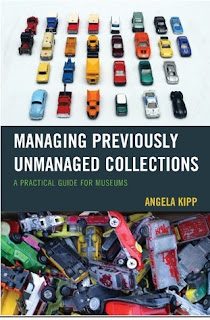
Reading List: Managing Previously Unmanaged Collections: A Practical Guide for Museums

Well look at me! I'm kind of so far sticking to this goal of reading through my pile of museum books to read! *pat on the back*  And now I'm back with another review!

I'd been reading Angela Kipp's blog "Registrar Trek" for a while, so I was really excited when she announced she was writing a book, and then again when she said it was being published. Her blog about the life of a registrar/collections manager was insightful and full of thought (well-written and thought out, as well "Huh, I never thought of that before. That's an interesting thing to keep in mind" thoughts), and often funny and crazy (Pictures of her driving a forklift always kind of scared me: "Do I need to learn how to drive a forklift to work in collections?!?"). So when her book came out, I immediately bought it, but then like so many other books I buy, it got put in a pile of books to read, and then sat there... and sat there... and sat there (as I suffered guilt about all the other books I was excited to read and bought... too many books, not enough time). Over the years, I read a few sections of the book that were relevant to something I was working on at the time, but I have only now read the whole book, cover to cover, and now I absolutely wish I had read it sooner!

One of things I love about this book is that it's not only about how to tackle the objects in a previously unmanaged collection (If you work in collections, or in a museum/historical society where you have access to the collections, you know what we're talking about: objects everywhere, piled up haphazardly, likely not in protective housing, maybe dirty; if you're the one who works with the collections, you know there are no numbers, no tags, no paperwork... *shudder*), but it's about the mindset you need to do the work. And it's not a "Get in there and get to it!" mindset; it's about focusing your time, your effort, your sanity, and even about knowing when to step away. Kipp gives us an overview and reminders on page 1 that immediately set the reader up for this work:

  1. Think of the whole collection, not single objects.
  2. You are a collections manager, now think like a project manager.
  3. See the big picture, work in small steps.
  4. Don't be spellbound by numbers.
  5. You are not the white knight.
  6. You are not a collections management machine.

She also includes "Logical Exits," which to me at first seemed like a loser's way of thinking ("What? You can't do the whole job? You're going to give up?!?"), but after I read about them, I realized that they make sense: There's a very good chance you can't do everything, either because the project is so large or there's not enough time, and sometimes you also just need to be able to step away for the sake of your sanity. Kipp includes 4 logical exits in working with and cleaning up previously unmanaged collections, and provides the reader with how to recognize and plan subsequent logical exits. As someone who pushes herself to exhaustion sometimes because she doesn't want to look like a failure, I appreciate that Kipp points out the importance of knowing these logical exits, "points at which you will have the collection in a condition that allows you to leave it for the next lucky person to take over [or to just step away for a while]... the points at which you can stop without risking that everything you've done so far... was a waste of time" (xii-xiii). 

But the book isn't just about being in the right frame of mind. Kipp talks about how to first tackle the mess, documenting where everything was when you first saw it; how to begin organizing the mess; how to organize the room it's going to go into; storage materials; dealing with the board, volunteers, and budgets; and even about making personal, human connections with other collections professionals, people in other industries, and people in your community who might be able to help you or advocate for you. She doesn't talk about nitty-gritty details like how to number a collection or which CMS to use; she leaves those aspects for other books. Instead, she starts waaaaaay back at the very beginning, which few other collections/museums books do. The numbering system or the database you use comes after you've been daunted by the scope of the collection/mess, and Kipp's book is one of the few (actually, the only one that I've seen, but she does reference a couple of others) that helps you tackle that daunting mess. 


Managing Previously Unmanaged Collections book cover
Managing Previously Unmanaged Collections: A Practical Guide for Museums, 2016
Angela Kipp
173 pages


The upsides:

  • This gives an overview of how to tackle collections messes, with great ideas of how to get started and the early steps you need to take.
  • Logical Exits that can keep you sane or give you "a goal toward which you can work" (172).
  • This book isn't just useful if you're starting at Square One. It's also good if you have some amount of organization and cataloguing, and her tips are useful even if you're decently organized and catalogued.
  • Her writing and the included horror and success stories make you feel like you have a friend in this work and you're not alone. Others have been through similar issues and have lived to tell the tales. 
The downsides:
  • I want a collections job even more now! I have so many ideas of how to jump in and get a mess under control! 

Overall: Yes, yes, read this! If you have the good fortune to work with a messy and unwieldy collection, you should read this book. If you have the good fortune to be the only person working with a messy and unwieldy collection, or you'll be leading a group that will work with the collection, you definitely should read this book. It won't give you all the answers, mainly because every situation is different, but it will give you a starting point, a healthy mindset, and plenty of good advice.